Harpers Ferry from Washington
An hour and a half northwest, two rivers meet under wooded cliffs at the town where John Brown’s 1859 raid lit the fuse — reachable by a cheap commuter train that runs weekdays only, on a schedule you photograph.
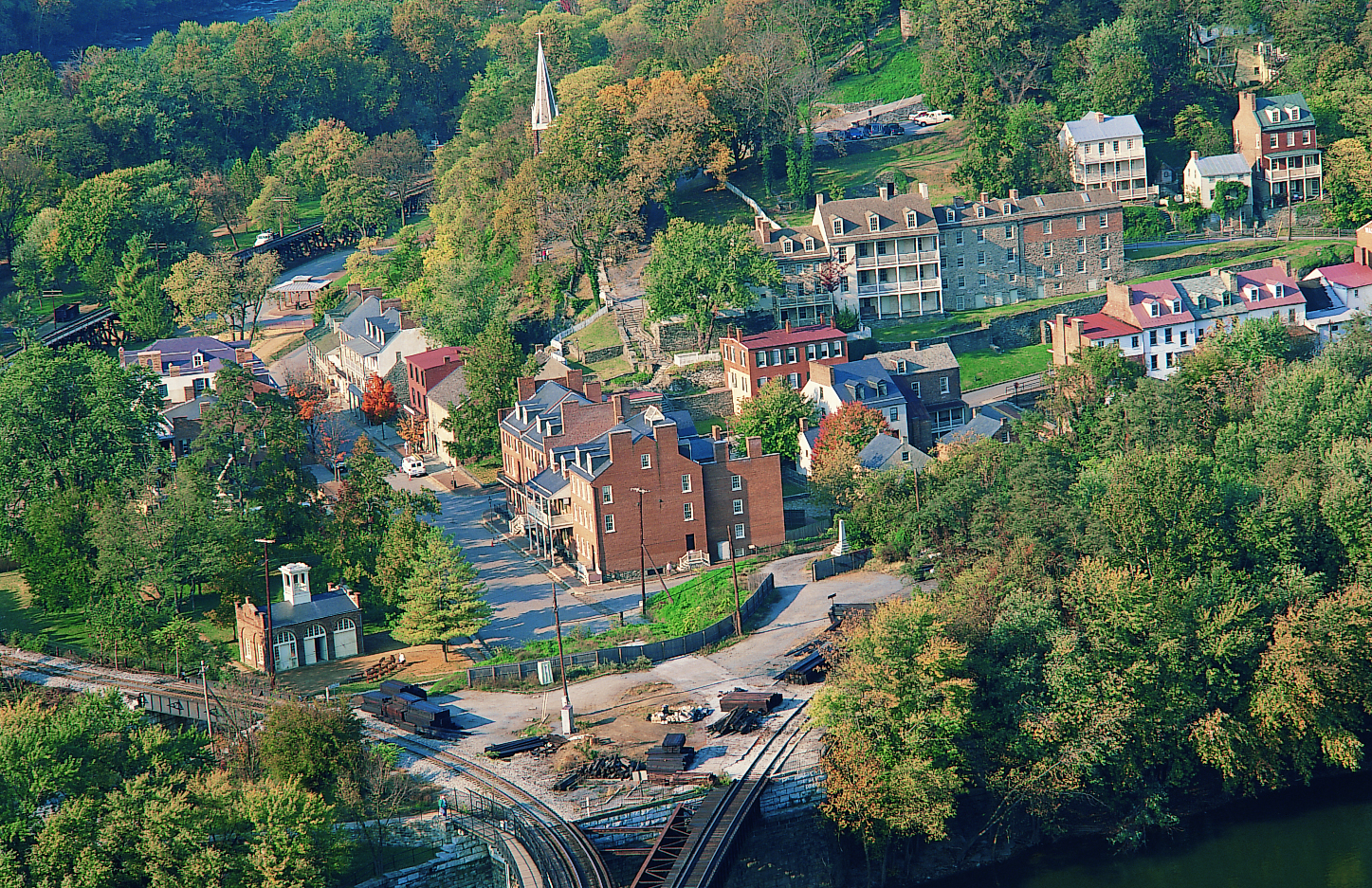
The short version
- MARC’s Brunswick line runs Union Station to Harpers Ferry in about 90 minutes at commuter fares — weekdays only, with the alarm’s one-out-one-back schedule photographed on arrival; Amtrak’s daily Capitol Limited covers weekends at Amtrak prices via amtrak.com, and drivers park at the visitor center for the shuttle.
- The station lands inside the historic lower town — the national historical park’s restored streets, museums, and the armory grounds — with entry logistics and trail maps at nps.gov/hafe.
- The history told straight: John Brown’s October 1859 raid seized the federal armory here intending to arm an uprising against slavery; it failed in 36 hours, Brown hanged that December, and the raid’s shock accelerated the country’s slide to civil war — the surviving fire-engine house, ‘John Brown’s Fort,’ stands as the park’s centerpiece.
- The town changed hands repeatedly through the war that followed — the park’s museums carry the armory, the war, and the postwar story of Storer College, the early Black college founded here, with the weight each warrants.
- The confluence is the setting’s argument: the Potomac and Shenandoah meeting under the cliffs, with Jefferson’s 1783 verdict — the scene ‘worth a voyage across the Atlantic’ — carved into the guidebooks from the rock platform bearing his name, a short climb up the town’s stone steps.
- The Appalachian Trail walks straight through town (the ATC’s headquarters sits here, psychological-halfway honors included), the C&O Canal towpath runs the Maryland bank, and Maryland Heights’ overlook — the alarm’s postcard view — climbs 2–3 hours round trip across the footbridge for the full town-and-rivers composition.

Getting there
The alarm’s timetable rule is the whole logistics: MARC’s weekday pattern runs its morning departure and evening return with nothing between — photograph it, set the alarm on your phone, and the day works cheaply and well; miss it and the recovery is Amtrak’s evening train or an expensive ride-share reality. Weekends belong to Amtrak’s once-daily timing or the drive-and-shuttle. The station’s position inside the lower town means zero transfer friction — you step off into 1859.
The day
Lower town first: John Brown’s Fort and the armory story taken at the register it asks — the raid, the trial, the war it hastened — then the museums’ street of exhibits (industry, war, Storer College, the Niagara Movement’s 1906 meeting here at civil-rights history’s headwaters) at self-guided pace. Climb the stone steps past St. Peter’s to Jefferson Rock for the confluence quote verified against the view. Lunch runs tavern-casual in the lower town. The afternoon splits by legs, per the alarm: Maryland Heights’ 2–3 hour round trip across the footbridge and up the Heights trail to the overlook where every postcard was taken — the town, the rivers, the water gap composed below — or the flat C&O towpath and the AT’s town stretch for the gentler version, with The Point’s river-meeting bench as the minimal correct answer. The photographed timetable calls the ending; the evening train runs the rivers home in the last light.
When to go
April to June and September to October run the trails and rivers at their best, with October’s foliage bringing the year’s crowds to the Heights trail — earlier trains and weekday visits, per the standing MARC logic, beat the wave. Summer adds tubing-and-rafting outfitters on both rivers and real heat on the climbs. Winter strips the town to its stone-and-history bones on Amtrak-or-drive logistics — quiet, stark, and open. Flood events occasionally close riverside paths; the park’s alerts page is the wet-season check.
Frequently Asked Questions
What actually happened in John Brown’s raid?
Brown and 21 men seized the armory the night of October 16, 1859, planning to arm enslaved people for a broader uprising; militia and then Marines under Robert E. Lee retook it within 36 hours. Ten raiders died, Brown was tried and hanged in December — and the raid’s polarizing shock is standard history’s fuse-lighting moment for the war eighteen months out. The fort and museums tell it with the plainness the alarm promised.
Is the Maryland Heights hike hard?
A real climb — roughly 4.5 miles round trip with steady grades on good trail — the alarm’s 2–3 hour budget fits most walkers with water and actual shoes. The overlook composes the entire visit in one frame; casual visitors get most of the geography from The Point and Jefferson Rock at a tenth the effort.
What’s the Appalachian Trail connection?
The AT crosses the Potomac footbridge and walks the town’s streets, with the Appalachian Trail Conservancy headquartered here — thru-hikers treat it as the trail’s emotional halfway and sign the register. Day visitors can walk a genuine AT mile without ceremony, which is the cheapest bragging right on the East Coast.
Is the park stroller and mobility friendly?
The lower town runs on historic grades and stone steps — the shuttle, the flat Shenandoah Street stretch, and the towpath work well; Jefferson Rock and the Heights don’t. The visitor center’s accessibility guide maps the honest routes.
Harpers Ferry or Annapolis from Washington?
Annapolis (documented on this network) for maritime-capital polish and midshipmen; Harpers Ferry for rivers, cliffs, and the raid’s hard history. Water versus mountains, dress shoes versus trail shoes — both run about the same travel time in opposite directions.